Blog
Cloud-native vs legacy hotel PMS: which wins.
How hosted and on-premise systems compare on uptime, updates, cost and integrations, and how to move without losing your data.
For most properties buying today, a cloud hotel PMS wins on remote access, running cost and the ability to connect to other tools. A legacy on-premise system still fits a narrow set of cases, usually strict data-residency rules or a chain with a large in-house IT team. This guide compares the two on the factors that decide the purchase, then covers how to move without losing your data.
If you are weighing providers right now, the questions below matter more than feature checklists. A system you can reach from anywhere, that is updated for you, and that connects to the rest of your stack will save more hours than any single headline feature. For what a PMS should cover in general, see choosing a hotel PMS.
What cloud-native actually means
A cloud-native hotel PMS is built from the start to run on hosted servers and reach staff through a browser, with no server in a back office. Cloud is already the most common way to buy: according to Grand View Research, cloud deployment took the largest share, 44.8% of revenue, of a hotel and hospitality management software market worth USD 4.2 billion in 2025. That figure covers hospitality software as a whole, not PMS alone, and it also means more than half of spending still goes to other models.
The term gets stretched, so check the substance. A cloud-native platform serves many customers from one codebase, is updated by the vendor, and keeps each customer's data separate. A legacy product reached through a remote-desktop window is not the same thing. Ask who applies the updates, and whether two of your properties can share one login and one live view.
How do uptime, updates and remote access compare?
Hosting moves the server, and the job of keeping it running, from your building to the vendor. A server in a back office depends on one building's power and network, and on whoever is on call when it fails. A hosted system depends on the vendor's infrastructure and processes, which vary a great deal between vendors. Large cloud providers publish formal availability commitments, such as the Amazon compute service level agreement, but a PMS vendor's own promise is what binds your hotel, and many make none. Ask for it in writing.
Updates are the second dividing line. With a hosted PMS the vendor applies fixes and new features, usually without anyone at the property doing anything. With a legacy system someone has to install each update, often in an after-hours slot to keep the front desk running. Neither model means zero downtime: hosted vendors still schedule maintenance, so ask when it happens and how you are told.
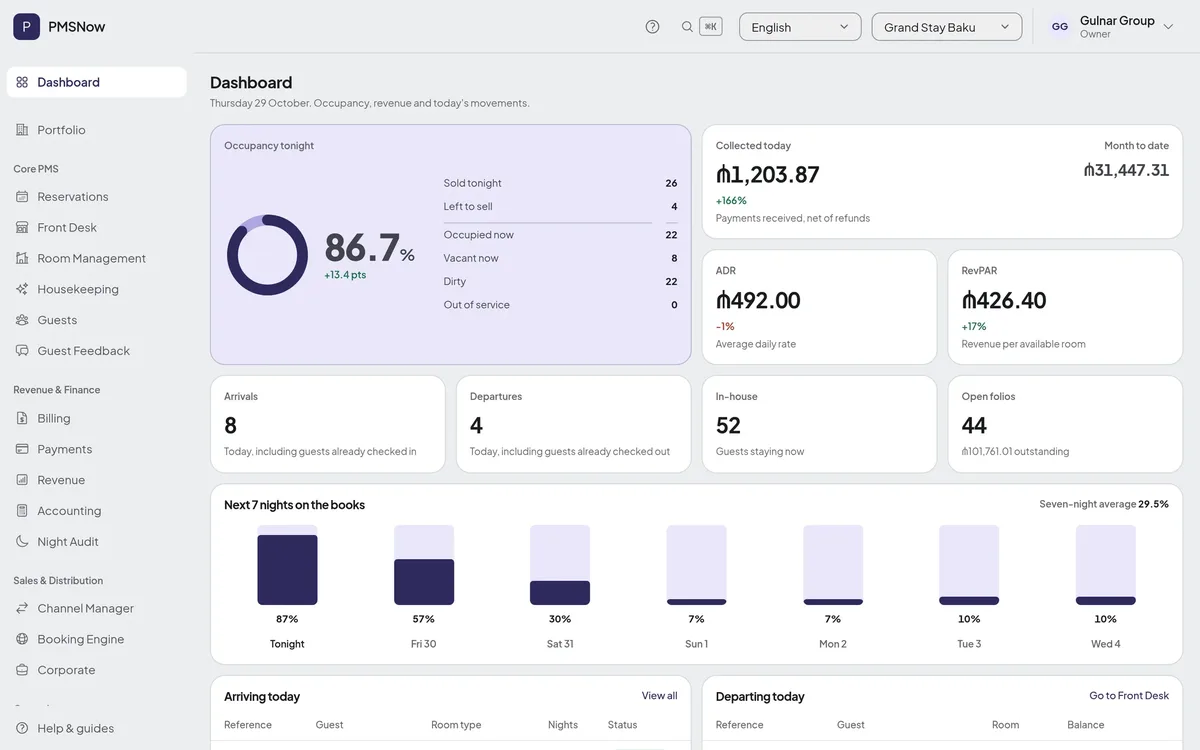
Remote access is where the gap is widest. With a browser-based system a manager can check arrivals, adjust a rate or read the night audit from home or from another property. Legacy software usually ties staff to a workstation on the hotel's own network.
A practical test for any provider: ask where the data is hosted, how often it is backed up, who restores it and how quickly, and what uptime they will commit to in your contract. A serious vendor answers each question in writing, including the ones where the answer is "we don't promise that".
Which costs more to own?
Legacy systems can look cheaper on day one and cost more over their life. The upfront licence hides what comes next: server hardware, a maintenance contract, the labour of patching, and work for each new integration. A hosted PMS folds hosting, updates and support into one recurring price.
The hidden items dominate the legacy bill. Someone has to own the server, replace failing drives and schedule the downtime patching requires. When a server dies, the property pays for emergency hardware and lost booking time at once. A subscription moves that risk to the vendor.
Scale changes the maths further. Adding a second or third property to a hosted platform is a set-up step, not a new server install. Grand View expects hospitality software as a whole to grow from USD 4.4 billion in 2026 to USD 8.4 billion by 2033, about 9.8% a year.
Compare total cost over five years rather than the first invoice: licence or subscription, hardware, hosting, support, updates, integrations and the staff time each one takes. For how we price ours, hosting, backups, updates and support are included, and there is no charge per user (see pricing).
Why integrations and open APIs matter
Open APIs pay off every month after purchase. They let the PMS exchange data with channel managers, payment gateways, booking engines and revenue tools, so you are not paying for custom middleware or waiting for the vendor to build each link. Closed platforms make every new connection a negotiation, and some never connect. For more on this, see why API-first architecture matters.
Check what is live, not what is on a roadmap. Our own PMSNow has a documented REST API for availability, price quotes, bookings and folios, with access tokens issued per hotel and signed webhooks when a reservation is created, changed or cancelled. Its connections to Booking.com, Expedia and Airbnb, to channel managers and to payment gateways are still marked "coming soon". Room and channel mapping and a rate preview are in place, but if you depend on a channel manager today, keep it.
How to migrate from a legacy PMS without losing data
Plan the move around a parallel run, not an overnight switch. Start by asking the legacy vendor for a full export: reservations, guest profiles, rate plans and history. Map each field to the new system, load a test batch and check it before committing the live data.
Sequence the cutover to protect the front desk. Run both systems side by side for a short window so staff can confirm that bookings, folios and reports match. Retire the old server only once the data reconciles. That step catches silent errors that a single-night switch would push straight into guest-facing work.
Treat training as part of the move. Browser-based systems are usually quicker to learn, but reception staff still need a dry run of the new check-in flow before a busy arrival day. For the wider process, see migrating from legacy software.
Questions about cloud and legacy PMS
What is a cloud-native hotel PMS?
A property management system built to run on hosted servers and used through a browser. Staff sign in from any device, the vendor applies updates, and there is no server at the property to maintain.
Is a cloud PMS cheaper than a legacy on-premise system?
Usually, over its life. A subscription replaces server hardware, maintenance contracts and patching labour with one recurring price. Compare five-year totals, including integrations and staff time, rather than the first invoice.
Can I keep my data when moving from a legacy PMS?
Yes, if you plan the export early. Ask for a full export of reservations, guest profiles and rate plans, map the fields to the new system, and check the records during a parallel run before the final cutover.
Why do open APIs matter when choosing a hotel PMS?
They let the PMS exchange data with channel managers, payment gateways and revenue tools directly, which cuts custom integration work and lets you add or swap connected services as you grow. Ask which connections are live today and which are planned.
Shortlist two or three hosted systems and put each through the same real scenarios: a night audit, a rate change made from a phone, and the connection you rely on most. The one that handles all of them without a workaround is the one to trust on a sold-out weekend. If you move to PMSNow, we bring your data across at no charge: send us a sample export and we will tell you what imports cleanly and what would need re-entering.